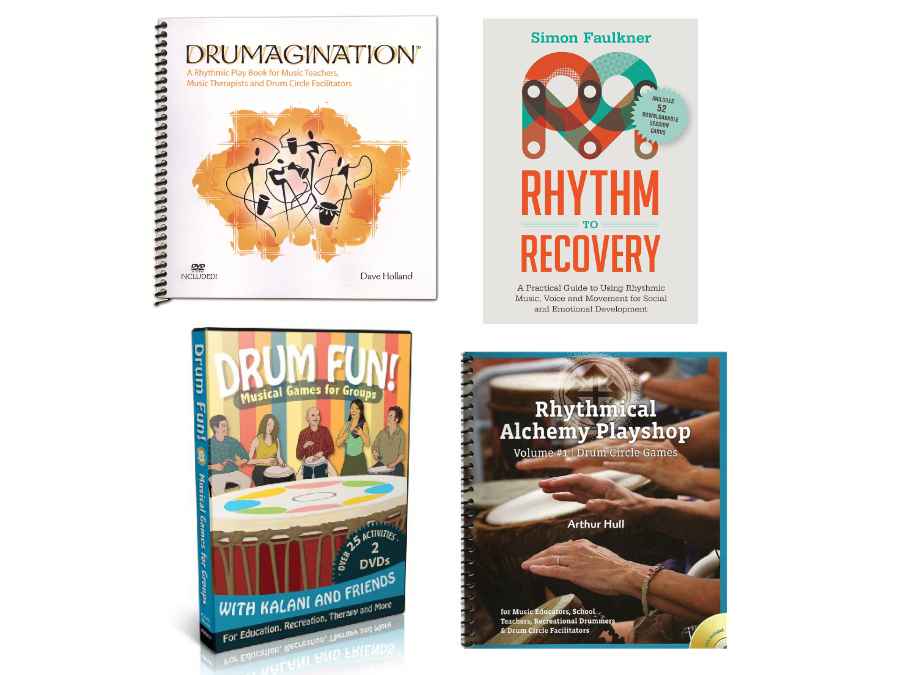
Facilitating drum circles well is its own skill set, separate from playing, separate from teaching in a traditional sense, and worth investing in seriously. The four books below are less about specific cultural traditions and more about the art of holding rhythmic space for a group: reading the room, sequencing activities, and building the kind of participatory energy that makes a drum circle actually work. If you teach with drums or run community music programs, they also translate directly into warm-ups and accessible entry points that sit comfortably alongside more tradition-rooted repertoire.
All four are worth owning. They cover different territory, and together they give you a genuinely well-rounded facilitation toolkit.
What is the purpose of drum circles?
The purpose of drum circles is to bring people together to make music as a group, whatever their experience. Unlike a performance, a drum circle is about participation: everyone plays, listens, and responds to the others, so the group creates something none of its members could make alone.
That simple structure serves several purposes, depending on the group:
- Community and connection. Playing a shared rhythm builds belonging, and groups that drum together often begin to form a shared group identity.
- Social and emotional learning. Drumming turns rhythm into metaphor, giving students a playful way to practice listening, turn-taking, and self-regulation.
- Wellbeing. Studies of group drumming with adults have shown measurable improvements in biological, psychological, and social measures of stress, particularly when reflection and self-disclosure are included.
- Music learning. Hand drums lower the barrier to entry, so beginners can start making music right away while experiencing what it’s like to play as a group.
- Cultural connection. Communal music-making is central to most indigenous cultures, and modern drum circles connect to those older traditions.
Which purpose matters most to you will shape which book you reach for, which is why the four below cover different territory. For the research and the West African roots behind these ideas, see my post on drum circles and social emotional learning.
Drum circles: quick comparison of the 4 books
| Book | Author | Price | Best for |
| 1. Drum Fun | Kalani Das | $20 | Low-barrier activities for groups with no prior experience |
| 2. Drumagination | Dave Holland | $29.95 | Easy-to-learn activities, each with a demonstration video |
| 3. Rhythmical Alchemy Playshop: Drum Circle Games, Volume 1 | Arthur Hull | Hard to find | Games that teach cooperative music-making in mixed-ability groups |
| 4. Rhythm to Recovery | Simon Faulkner | $18–$38 (Kindle or paperback) | SEL-focused drumming in school, counseling, and community settings |
The 4 best drum circle books for facilitation
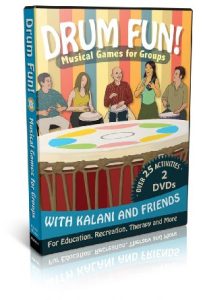
1. Drum Fun by Kalani Das
$20 | Best for: groups with no prior experience
Drum Fun offers over 25 rhythm, movement, and voice activities designed for group settings, presented by Kalani Das, a widely respected music educator and music therapist. The activities work across a broad range of populations and contexts, from elementary classrooms to recreational community drumming, and most can be done with or without instruments. If you’re looking for a low-barrier entry point for groups with no prior experience, this is a reliable starting place.
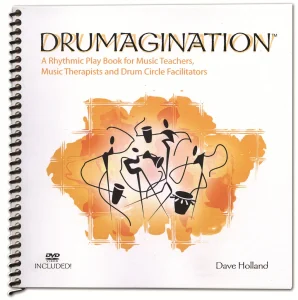
2. Drumagination by Dave Holland
$29.95 (eBook or spiral-bound) | Best for: facilitators who want to see each activity demonstrated before leading it
Drumagination comes from Dave Holland, a nationally recognized percussionist and drum circle facilitator, and it reflects the kind of practical, field-tested thinking that comes from years of working with real groups. The activities are designed to be easy to learn and quick to get moving. Each one comes with a step-by-step demonstration video, which makes it easy to pick up activities without having seen them modeled live. It’s available as an eBook or spiral-bound, and it’s well-regarded among professional facilitators.
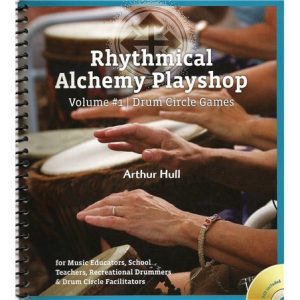
3. Rhythmical Alchemy Playshop: Drum Circle Games, Volume 1 by Arthur Hull
Hard to find | Best for: mixed-ability classroom and community groups
This one is genuinely hard to track down, but worth the effort. Arthur Hull is one of the founding figures of facilitated drum circles as a practice, and this book, the first in his Rhythmical Alchemy Playshop series, reflects that. It focuses specifically on hand drumming games for groups sitting in a circle, though most activities adapt easily to mixed hand percussion or full percussion setups.
What sets it apart is the underlying philosophy. These aren’t just games; they’re designed to teach participants something about cooperative rhythmic music-making as they play: how to listen, how to respond, and how a circle functions as a musical system. All ages and experience levels can participate simultaneously, which makes it particularly useful in mixed-ability classroom and community settings. The accompanying DVD is where a lot of the value lives, so look for a copy that includes it.
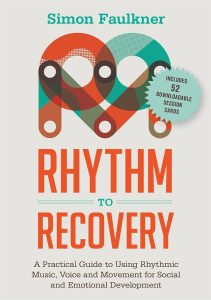
4. Rhythm to Recovery by Simon Faulkner
$18–$38 (Kindle or paperback) | Best for: SEL-focused drumming in school, counseling, and community settings
Rhythm to Recovery sits at the intersection of drumming and social-emotional learning in a more explicit way than the others. Faulkner draws on current research about how rhythmic music affects the brain and builds over 100 exercises around five developmental areas: social and emotional learning; identity and culture; strengths and virtues; health and wellbeing; and family, team, and community. The exercises span a wide range of settings: school, counseling, mental health, trauma, and family contexts.
For music educators, the most immediately useful entry point is Faulkner’s concept of “heartbeat rhythms” as a starting point for groups new to drumming. It’s an approach that works surprisingly early. I’ve had success using it with students as young as second grade to get a drum circle up and running from scratch. The book also includes downloadable session cards, evaluation forms, and facilitation guidance for working with specific populations and managing challenging group dynamics.
Which book should you start with for drum circles?
You don’t need all four books on day one. Here is how I would choose:
- Brand-new groups with no experience? Start with Drum Fun.
- Want to see activities modeled on video? Choose Drumagination.
- Want the philosophy behind facilitated circles? Look for Rhythmical Alchemy Playshop, ideally a copy that includes the DVD.
- Working in SEL, counseling, or mental health settings? Pick up Rhythm to Recovery.
Start with whichever matches the groups you actually work with, then add the others over time.
Connecting facilitation to world music and SEL
If drum circle facilitation is a thread running through your teaching, it connects more naturally to world music and SEL practice than it might first appear. My posts on drum circles and social emotional learning and djembe drumming for beginners are good places to explore that connection further, particularly if you’re thinking about how to ground community drumming in something culturally specific rather than treating it as a genre-neutral activity. For ready-to-use activities, try these drum circle games that teach sound science.
The best drum circles, in my experience, are the ones where the facilitator has both the practical toolkit and a genuine sense of what the music is rooted in. These books help with the first part. The rest of this site is here for the second.