Djembe drumming for beginners starts with choosing the right teacher, and there is no shortage of options online. The djembe pulls people in from every direction. Some come to it through a drum circle, others after witnessing African masters perform the instrument. However you found your way to the djembe, these four resources, plus two practice apps, are the ones I think are worth your money if you want to learn djembe online.
Djembe drumming for beginners: quick comparison
Resource | Price | Best for |
Monette Marino Drum School | $10–$30/month | Traditional Guinean rhythms and original Mamady Keïta solos |
DJEMBE FLOW | Free download; $38/month (7-day trial) | A sequenced, step-by-step progression |
Michael Pluznick | $20/month | Djembe from beginner to pro, plus dunun and Afro-Cuban percussion |
Kalani Das (Patreon) | $10–$35/month | Drum circle facilitators and classroom teachers |
Before you start: the three basic djembe sounds
Nearly every beginner djembe lesson begins with three sounds. The bass is a deep, low note played with the whole hand in the center of the drum. The tone is a rounder, open note played with the fingers near the edge. The slap is a sharp, cracking note, also played near the edge with relaxed fingers. Whichever resource you choose, expect to spend your first lessons getting comfortable with these, and short, regular practice will serve you better than one long session a week.
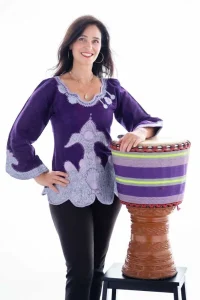
1. Monette Marino Drum School: Traditional Guinean Djembe
$10–$30/month (YouTube channel membership) | Best for: beginners who want a Guinea-trained teacher and a path into traditional rhythms and solos
Monette Marino spent the better part of two decades studying directly under master drummer Mamady Keïta from Guinea. She received her Teaching Certificate from Keïta in 1999, her full Tam Tam Mandingue (TTM) diploma in 2011, and managed Mamady’s world tours from 2004 to 2012, a level of proximity to the tradition that’s genuinely rare. She’s also a two-time National Hand Drum-Off winner.
Monette teaches many traditional rhythms from Guinea, but what makes this membership distinctive is access to a series of original djembe solos composed by Mamady Keïta himself. They are available nowhere else online, and they are broken down and taught exceptionally. The membership also includes djembe warm-up content, a good place for a beginner to start, and documentaries about Mamady Keïta that I haven’t found anywhere else.
2. DJEMBE FLOW: A Step-by-Step Djembe App
Free download, $38/month subscription (7-day trial) | Best for: beginners who want a sequenced, structured progression
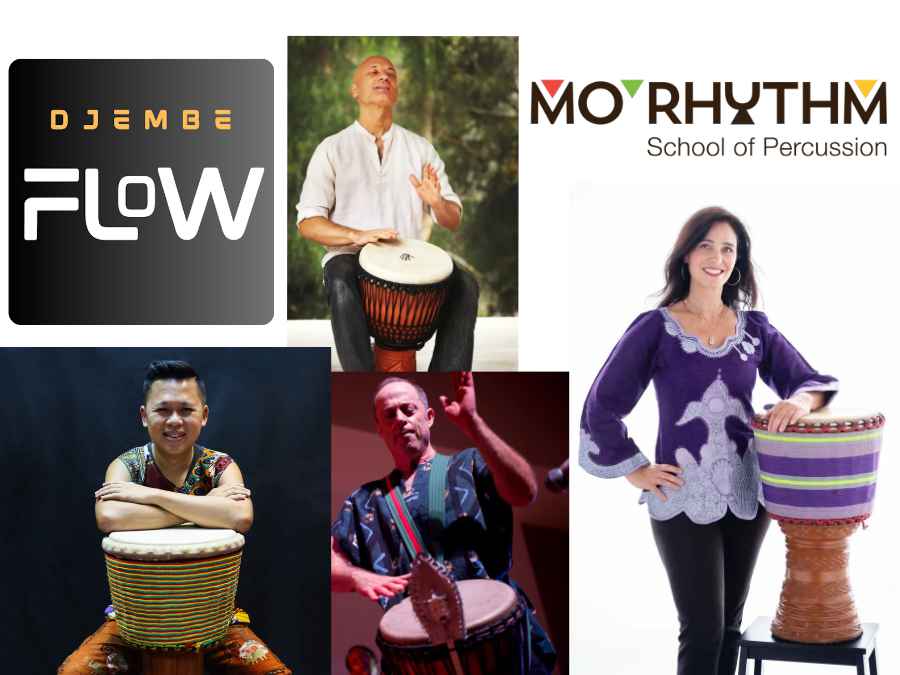
DJEMBE FLOW was created by Kelvin Kew, a student of Mamady Keïta and now the leader of Tam Tam Mandingue Djembe Academy. It is one of the most pedagogically coherent apps available. The content follows the worldwide TTM curriculum that Kelvin has maintained from mast drummer Mamady Keïta, so you’re not navigating a loose collection of videos but working through a sequenced, tradition-rooted progression grounded in Guinean practice.
The app includes daily technique exercises, workshop-drawn lessons, live lesson content with solo phrases and unison breaks, and regularly updated rhythms, solos, and backing tracks. Kelvin has been teaching internationally since 2011 and founded Fanka Fellas, Asia All Stars for Africa, and Djembe Singapore Club, bringing the Mamady Keïta lineage into a robust Asia-Pacific teaching community.
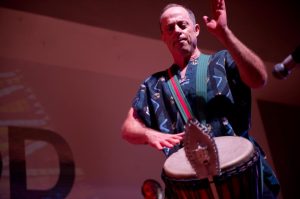
3. Michael Pluznick: Online Djembe Courses From Beginner to Pro
$20/month | Best for: beginners who want room to grow, or who also want Afro-Cuban percussion
Michael Pluznick has thirty-plus years of teaching experience and a training history that reads like a map of the tradition: Afro-Cuban study in Havana, training with Mamady Keïta, Karamba Diabáté, and Bolokada Condé, two trips to Mali and one to Guinea, performances alongside Olatunji, and recordings with Mickey Hart.
His online courses span djembe from beginner through professional level, plus a dedicated dunun course, congas, bongos, and shekere. That makes this one of the few memberships where you can explore both djembe and Afro-Cuban hand percussion side by side at every skill level. If you’re a music educator looking to build fluency across multiple traditions, this breadth is hard to find elsewhere. His social media is also worth following, since he shares technique tips and performance content consistently.
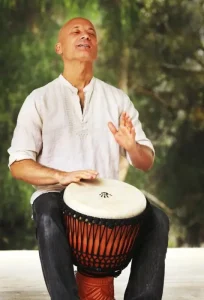
4. Kalani Das on Patreon: Djembe and Drum Circle Lessons
$10–$35/month | Best for: drum circle facilitators and classroom teachers
Kalani Das is a professional percussionist, educator, and music therapist whose Patreon subscription covers an unusually wide range: djembe, congas, bongos, cajón, traditional rhythms, ukulele, tuned percussion, and drum circle facilitation guidance.
If you’re drawn to the intersection of community music-making, music therapy, and cultural percussion traditions, this is a compelling option. It won’t replace deep lineage-based study, but for drum circle facilitators and classroom teachers who want practical support across multiple instruments, the breadth is genuinely useful. If that sounds like you, you may also like my post on drum circles and social emotional learning.

Two apps for practicing djembe at home
These two apps look similar on the surface: both were created by students of Mamady Keïta, and both offer notated rhythms for free with paid upgrades. Each has distinct strengths worth knowing.
djembeföla! (iOS)
Free with in-app purchases, about $15 per rhythm bundle | Best for: building a personal practice around authentic repertoire
The name of djembeföla! is itself instructive: djembefola is the Mande word for a djembe player, literally someone who speaks the drum. The app organizes West African rhythms by difficulty level and includes a full section on the Dununba family, the powerful festival rhythms associated with celebrations of strength and community.
MoRhythm-Africa (iOS)
Free with in-app purchases, about $5 per rhythm bundle, plus $0.99 to unlock video | Best for: beginners and anyone interested in the full djembe ensemble
Developed by Monette Marino, MoRhythm-Africa has a key practical advantage: downloadable video content for offline use. It also includes instructional material not available in djembeföla, notably video instruction on playing dununs in ballet style, the stage-performance tradition developed through the national ballets of Guinea and Mali. This makes it particularly valuable for beginners and for anyone interested in the full djembe ensemble, not just the lead drum. The lower per-bundle cost makes it an affordable entry point.
Which resource is best for djembe drumming for beginners?
When it comes to djembe drumming for beginners, you don’t need to subscribe to everything. Here is how I would choose:
- Want a clear, step-by-step path? Start with DJEMBE FLOW.
- Want a Guinea-trained teacher and Mamady Keïta’s solos? Choose Monette Marino Drum School.
- Want djembe plus Afro-Cuban percussion at every level? Try Michael Pluznick’s courses.
- Teach or facilitate drum circles? Kalani Das’s Patreon is the most practical fit.
- Want to practice rhythms on your phone? Try MoRhythm-Africa, then add djembeföla! if you want more repertoire.
Whatever you choose, pick one resource and stay with it long enough to build your basic sounds before adding another. Djembe drumming for beginners is less about finding the perfect course than about showing up to practice. And if you’re building a classroom or community program, my drum circle games that teach sound science are a fun next step.