A series of fun drum circle games that bridge to this Amplify Science Light and Sound Unit
What if your drum circle was also a science lesson? In this Amplify Science Grade 1 Light and Sound unit, students take on the role of sound engineers for a puppet theater company — and their job is to find the right sounds to bring their scenes to life. The three activities below offer a playful, embodied entry point into that exact challenge. Long before students sit down with a design plan, they can explore the relationship between vibration, playing technique, and sound through the drum circle games Squirrels in the Oak Tree, Follow My Feet, and Rumble Ball, an activity from Kalani Das.
Each activity invites participants to listen closely, match sounds to movements or stories, and discover that the instruments in their hands are tools for communication. That is the heart of the Amplify Science Unit: sound is purposeful, sound is designed, and sound can tell a story.
Learning Objectives
- Students will identify vibrating objects as the source of sound (1-PS4-1)
- Students will demonstrate that sound can be started and stopped by controlling vibration (1-PS4-1)
- Students will apply cause-and-effect reasoning to connect playing techniques to the sounds they produce (Crosscutting Concept: Cause and Effect)
- Students will plan, test, and select sounds to meet a design goal (K-2-ETS1-2, K-2-ETS1-3)
The Activities
Squirrels in the Oak Tree
Story Game
This participatory story game explores a range of drum sounds and playing techniques. As the facilitator, you narrate the story while guiding the group to create live sound effects on their drums. In the context of the puppet theater unit, this is a chance for students to discover that every playing technique carries its own character — and that sound can be chosen and controlled intentionally.
Sounds Used:
Drums
Setup:
Inform students you will be cueing them to make sounds to accompany a story using specific playing techniques to create special effects with their drums. Ask them to listen for the line in the story and the instructions on what to play. Alternatively you can explore each of the sound technique first and then cue them throughout the story.
The Story:
FACILITATOR: “Deep in the woods stood a grand old oak tree with a cozy hollow near the top. One autumn day, a squirrel discovered it and moved right in.”
- GROUP SFX: One fingernail scratching lightly across the drumhead
FACILITATOR: “Before long, a second squirrel — a very charming one — moved in to join the first.”
- GROUP SFX: Two fingernails scratching
FACILITATOR: “By spring, the hollow was full of little squirrels.”
- GROUP SFX: All ten fingernails scratching
FACILITATOR: “Life in the oak tree was wonderful — until the squirrels decided to throw the biggest party the forest had ever seen. They invited all their neighbors, and their neighbors invited their neighbors… The squirrels invited the rabbits.”
- GROUP SFX: Open tones
FACILITATOR: “The rabbits invited the foxes.”
- GROUP SFX: Fingers scampering quickly across the drumhead
FACILITATOR: “The foxes invited the woodpeckers.”
- GROUP SFX: Knuckles rapping on the wooden shell
FACILITATOR: “The woodpeckers invited the snakes.”
- GROUP SFX: Fingers dragging/sliding slowly across the skin
FACILITATOR: “The snakes invited the bears.”
- GROUP SFX: Deep, thumping bass tones
FACILITATOR: “Everyone was having a magnificent time… until someone yelled “fire!”
- GROUP SFX: Mix up all of the different sounds chaotically
FACILITATOR: “And the old oak tree shook and fell over with one tremendous BOOM!”
- GROUP SFX: bass rumbles starting quietly and growing loud until cueing one last loud bass tone.
What this builds: Exploring playing techniques and sound effects through imaginative storytelling
Follow My Feet
This activity builds hand/eye coordination by connecting drum sounds to movement happening in the center of the circle. For puppet theater sound engineers, it captures exactly the real-time listening and responding that sound design requires: something moves, and the sound has to match. It is also a natural, low-pressure way to invite participants into a leadership role.
Sounds Used:
Drums, hand percussion
Setup:
Start with a simple prompt: “Every time my foot touches the ground, give it one sound.” Wait for the group to lock in before moving on.
The Play:
- Once the group is responding consistently, open it up: “What other sounds could you make to match what my feet are doing?”
- Experiment with a range of foot movements — tiptoeing, stomping, shuffling, sliding, or even a moonwalk moment — and let the group find sounds to match each one.
- Invite one or more participants into the center to take over, leading the group with their own footwork and sound choices.
Variations:
- Expand beyond feet: try an arm wave, a shoulder shimmy, or a slow spin and see what sounds the group suggests.
- You can add colored pieces of paper that cue specific sounds, such as vocal sounds, when they are stepped upon or touched.
What this builds: Leadership empowerment, creative listening, and inclusive movement vocabulary
Rumble Ball
This activity invites participants to match sounds to movement in real time — and then goes a step further by asking them to think about why certain sounds fit certain movements. This game is adapted from Kalani Das’ activity of the same name, available for free here. I highly recommend purchasing his Musical Games for Groups activity series from the same link, a fantastic resource for drum circle games like those found in this blog post.
This is the richest layer of science thinking in the set, and the one most directly connected to the design work of the puppet theater unit. When students sort instruments by qualities like high or low, sudden or sustained, they are developing the vocabulary and judgment they will need when it is time to choose sounds that actually fit a scene.
Sounds Used:
Drums, hand percussion — bells, shakers, blocks, and anything else in your collection
Materials:
A small rubber ball — a playground ball around 8″ works great
Setup:
Gather in a circle or semi-circle with instruments at the ready.
The Play:
- Toss, bounce, and roll the ball and ask participants to make sounds that match what the ball is doing. Give it a minute or two for the group to find their footing.
- Once things are flowing, pause and ask: “What words describe how the ball moves when I toss it? When I bounce it? When I roll it?” Collect adjectives from the group — things like high, light, sudden, heavy, smooth, sustained.
- Work through each movement one at a time. For each set of descriptors, ask: “Which instruments in our circle share those qualities?” A toss that is high and floaty might call for triangles and jingles. A heavy roll might belong to the bass drum.
- Assign each movement its instrument group and practice the full sequence together.
- As a bonus layer: explore how a single instrument can cover more than one action through different techniques — a frame drum might scrape for rolling and ring out for a bounce.
- Invite participants to take over ball duty. Try having two leaders at once for some creative chaos!
Variations:
- Start with voices before bringing in instruments — it lowers the barrier and gets some great vocalizing going.
- Try an invisible ball. An imaginary ball can be any size, fly as high as you want, never rolls out of the circle, and is always available. It never fails to bring out creativity and laughter.
What this builds: Timbre awareness, descriptive language, instrument exploration, and peer leadership
Connecting It All: The Science Behind the Play
In this Amplify Science Light and Sound unit, students step into the role of sound engineers with a real challenge: the puppet theater company needs sound effects to bring their scenes to life. They hunt for sound sources, investigate how sounds are made, and design, test, and revise their own sound-making solutions.
These three drum circle activities give students a playful, hands-on space to begin that thinking. In Squirrels in the Oak Tree, every playing technique — a fingernail scratch, a knuckle rap, an open tone — produces a distinct sound tied to a specific vibrating action. Students discover that sound can be started and stopped on cue, and that different techniques create different effects. This is the foundation of what Amplify Science asks students to understand.
Follow My Feet builds on this by asking the group to make real-time sound decisions to match a moving image — exactly the kind of listening and responding that sound engineers do when designing effects for a scene.
Rumble Ball brings the deepest layer of design thinking. Sorting instruments by qualities like high or low, sudden or sustained is informal sound engineering — the same process students will use when choosing the right sound for their puppet show scenes.
By the time students sit down to plan their sound effects for the puppet theater company, these activities will have already given them a body full of sounds and experiences to draw from. The drum circle becomes the first draft of the design process.
Capturing the Learning
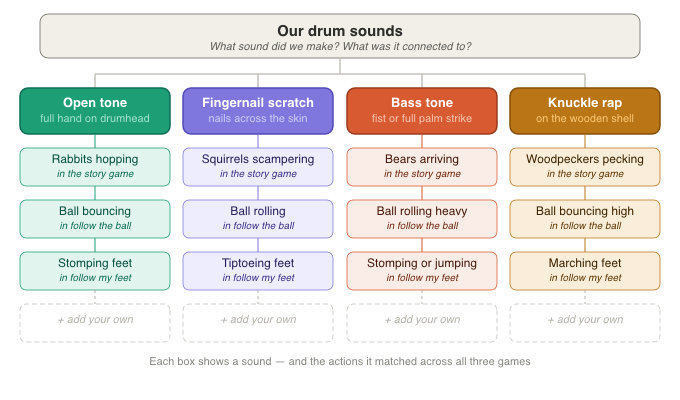
A thinking map is a great way for students to capture their learning from these activities. Using a Tree Map to align each drum or percussion sound to a movement or story character is the most expedient method. Here is an example Tree Map:
Percussion as the storyteller
This is a direct connection to the drum circle games and exposes students to an important art of another culture. In Beijing Opera, percussion instruments — gongs, cymbals, drums, clappers — drive the action on stage in real time, punctuating every flip, fight, and dramatic moment. The percussion is live, responsive, and inseparable from the performance. For students who have just been creating live sound effects in the circle, this is a powerful mirror of what they were doing — and a window into a rich, ancient tradition that honors exactly that skill.
For further investigation into sound effects, search for foley artists on YouTube for some fun videos on the many ways sound effects are created for TV, movies and video games.
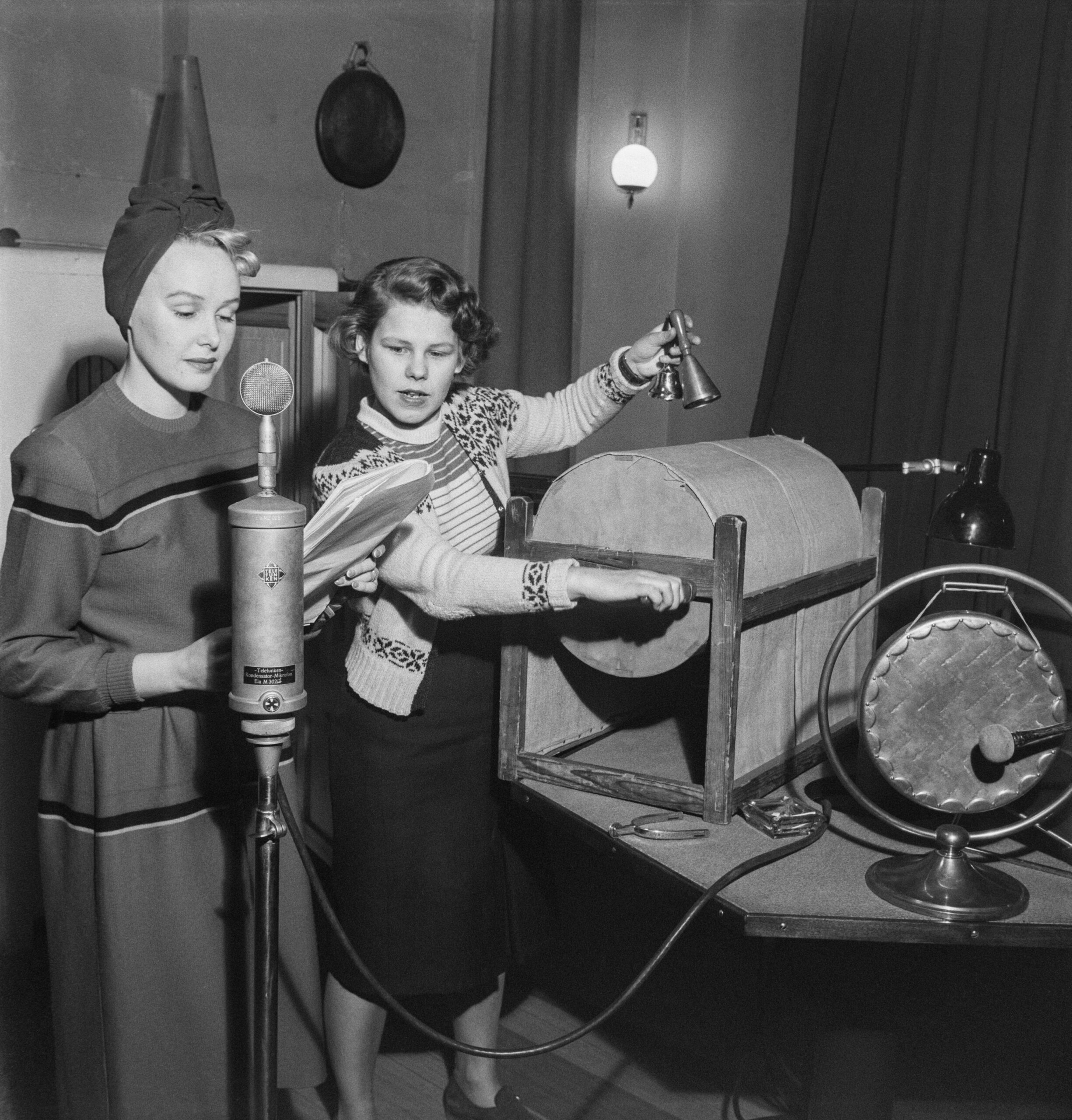
Photo by Yle Archives on Unsplash