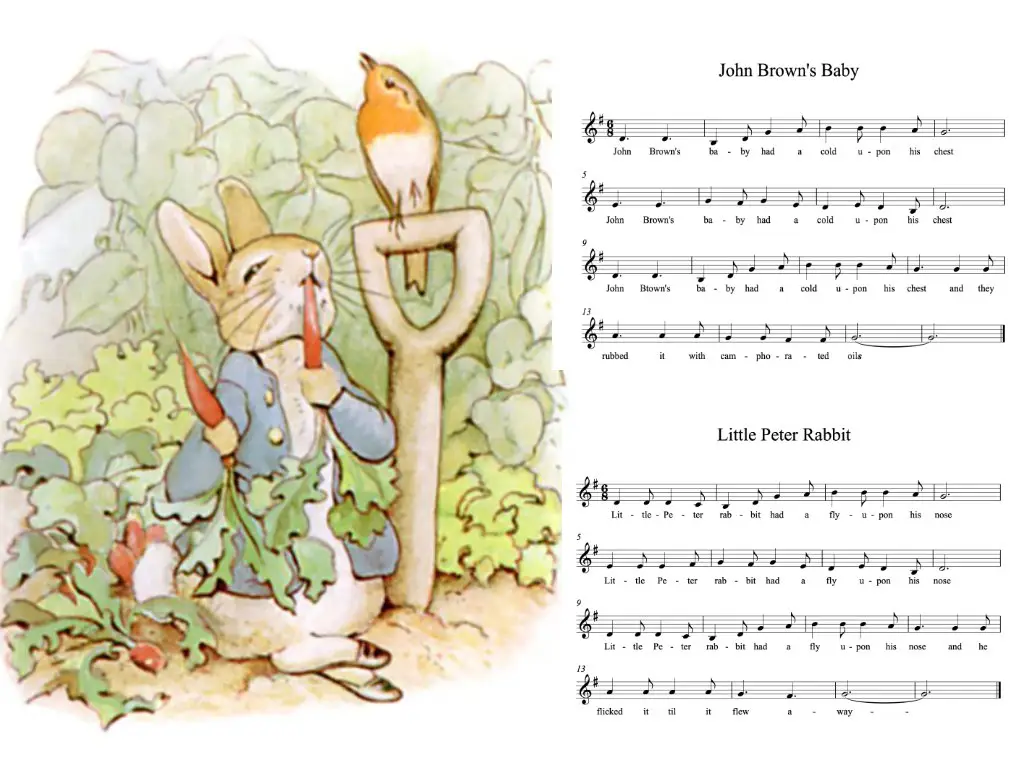
These songs connect with this post that demonstrates this melody’s place in history
Little Peter Rabbit
Pre-K through Grade 1 · approx. 12–15 minutes
Learning Objectives:
- Students will identify the melody of a song as the part that can be sung, hummed, or whistled, and recognize that the same melody can carry different words.
- Students will demonstrate understanding of the term melody by identifying a shared melody across two or more songs with different lyrics.
LYRICS
Little Peter Rabbit had a fly upon his nose, (repeat twice)
And he flicked it ’til it flew away.
ACTIONS
rabbit — both hands up beside the head, fingers extended like floppy ears
nose — point to nose with one finger
flicked — one hand held flat, other hand’s finger flicks an imaginary fly off it
flew away — open both hands and flutter them like wings drifting away
PEDAGOGICAL RATIONALE
We approach the teaching of the song by introducing one action at a time across successive hearings — each time the teacher sings the whole song — students hear the complete melody repeated four times before they are ever asked to sing it themselves. Each pass has a clear, simple task that anchors attention without overwhelming it. By the time singing is invited, the melody is already familiar in the ear, and the actions are already in the body.
Underpinning the entire sequence is John Feierabend’s principle that the teacher sings for the class, never with the class. By introducing a new action each time novelty is maintained and the “split-second singing” habit of the teacher singing with the students is avoided. By stepping back at the moment of student singing — joining in the actions but not the melody — the teacher signals that the song now belongs to the students, and listens to hear what may be needed.
BEFORE YOU BEGIN
Students are seated on the floor in a circle or scatter formation with room to move.
Step 1 — First hearing: rabbit ears only (teacher sings, one action introduced)
Tell students: “I’m going to sing a song. When you hear the word rabbit, put your hands up like rabbit ears.” Demonstrate the rabbit ears — both hands up beside the head, fingers extended like floppy ears — then immediately begin singing.
Sing the song all the way through. Students listen for “rabbit” and respond with the ears each time it occurs. Nothing else is expected of them.
After finishing, briefly acknowledge what they did: “You heard rabbit every time — nice listening.”
Step 2 — Second hearing: add nose
“This time, keep doing the rabbit ears when you hear rabbit — and now, when you hear nose, point to your nose.” Demonstrate the nose point, then sing the song through again immediately.
Students are now tracking two cue words across the full melody. The action for rabbit is already familiar; nose is new but simple. The melody has now been heard twice in its entirety.
Step 3 — Third hearing: add flicked
“Keep your rabbit ears and your nose point — and now when you hear flicked, do this.” Demonstrate the flicking motion — the hand’s finger flicking an imaginary fly off it. Sing the song through again.
Three cue words, three distinct actions, third complete hearing of the melody. Most students will be visibly anticipating the cue words by now, which is exactly the sign that the melody is beginning to live in their ear.
Step 4 — Fourth hearing: add flew away
“One more — when you hear flew away, open your hands and let them flutter away like wings.” Demonstrate, then sing the song through a final time with all four actions now in play.
By the end of this pass, students have heard the complete melody four times, they have four actions anchored to four specific words, and they have not yet been asked to make a single sound.
Step 5 — Students sing: teacher does actions only
“Now it’s your turn to sing. I’m going to do the actions and listen to you.”
The teacher stops singing entirely and joins the students only in the actions — rabbit ears, nose point, flick, flew away — performed at the right moments in the melody.
Invite two or three repetitions and sing it again for the class if needed. Students who are not yet ready to sing can continue doing the actions, which is a valid and musically engaged form of participation. The teacher’s presence in the actions keeps the group together rhythmically without propping up the pitch.
John Brown’s Baby
Pre-K through Grade 2 · approx. 12–18 minutes
LYRICS
John Brown’s baby had a cold upon his chest, (repeat three times)
And they rubbed it with camphorated oil.
ACTIONS
John Brown — salute
baby — cradle arms and rock side to side as if holding an infant
cold — wrap both arms around yourself and pretend to cough
chest — pat chest firmly with an open hand
rubbed — circular rubbing motion on chest with one hand
camphorated oil — pinch nose shut with two fingers and make a sour ‘it stinks’ face
PEDAGOGICAL RATIONALE
Everything that applies to Little Peter Rabbit applies here, with one additional layer. Because John Brown’s Baby has six substitution words rather than four — and because ‘camphorated oil’ is unfamiliar vocabulary — the one-action-at-a-time approach is useful. Each successive hearing gives students another pass at the full melody while also giving them time to absorb and physically anchor a new word before the next one is added. By the time the group sings together, they have heard the song six times, and every key word has been introduced in context rather than in advance.
Following Feierabend’s principle, the teacher sings for the class during every teaching pass, and then steps back completely at the moment of student singing — participating only in the actions.
Then the lesson moves to the substitution activity of the lesson.
BEFORE YOU BEGIN
Students seated on the floor with space to move. No pre-teaching of vocabulary or actions. If students have already learned Little Peter Rabbit, open with: “I’m going to sing a new song. See if you can tell me what is similar to the last.” Sing the song first without actions and hopefully someone will recognize the melody. If not, you can ask “does it remind you of another song we have learned?” Hum the melody and add the words from Peter Rabbit if people still don’t get it.
Let the student know that the part of the music that is shared between both songs is called the melody, which is what can be whistled or hummed and stays the same even if the words are changed.
Note on vocabulary: if a student asks what camphorated oil is, say ‘a very strong-smelling rub that old-fashioned families put on sick babies — you’ll see what I mean when we get to that part.’
Step 1 — First hearing: baby only (teacher sings, one action introduced)
“When you hear the word baby, rock your arms like you’re holding a baby.” Demonstrate the cradle-and-rock motion, then begin singing immediately. Sing the full song through. Students listen for “baby” and rock their arms each time it occurs.
Step 2 — Second hearing: add cold
“Keep rocking for baby — and now when you hear cold, mime a coughing motion.” Demonstrate a small pretend cough with your fist in front of your mouth. Sing the song through again.
Two actions now. Students are beginning to build a listening map of the song — they know where “baby” lives in the phrase and are now locating “cold” for the first time.
Step 3 — Third hearing: add chest
“Keep your baby rock and your cold cough — and when you hear chest, pat your chest.” Demonstrate a firm open-handed pat on the sternum. Sing through again.
The three cue words fall in close proximity in the lyric (“baby had a cold upon his chest”), which means students are tracking a dense cluster of actions in a short phrase. If needed, fractionally slow your tempo through that phrase without disrupting the overall feel.
Step 4 — Fourth hearing: add rubbed
“Now add rubbed — when you hear it, rub your chest in a circle.” Demonstrate the circular rubbing motion. Sing through again.
“Rubbed” and “chest” sit close together in the lyric, making this the most physically demanding pass so far. That density is manageable because each motion was introduced one at a time and the melody is now genuinely familiar.
Step 5 — Fifth hearing: add camphorated oil
“Last one. When you hear camphorated oil — the smelly part — pinch your nose and make your best ‘that stinks’ face.” Demonstrate with full commitment. Sing through the complete song one final time with all five actions in play.
Step 6 — Students sing: teacher does actions only
“Now you sing it. I’m going to do the actions and listen to you.”
The teacher stops singing entirely. For every subsequent repetition in this lesson — including the substitution rounds — the teacher participates only through the actions, never through the voice.
Invite two or three repetitions. Watch and listen. Note who is tracking the cue words independently, who is watching neighbors for the action cues, and whose voice is carrying the melody with confidence. All of this is assessment information that arrives only because the teacher is silent.
Step 7 — Partial substitution: cough becomes mime
“Now cold disappears — instead of singing it, just do a short cough.” Teacher sings and demonstrates then students sing everything except “cold,” which becomes a short cough. The teacher does the action too, and nothing else.
Step 8 – cough and chest pat become mimes
“Now chest disappears as well — just the pat, no word.” Teacher sings and demonstrates then students sing again with both “cold” and “chest” now mimed. These two words sit right next to each other in the lyric, so their removal creates a small pocket of sound effects. The teacher remains in the actions only throughout both rounds.
Extension
- Continue substituting the movements as mimes until most of the song is audiated
- Substitute lyrics on the same melody from one of the many versions found on this page. For example: Suffragette ‘Hallelujah Song’ or ‘Battle Hymn of Women’ for Women’s History Month or ‘Move on Over’ or ‘Marching Song of the First Arkansas’ for Black History Month