
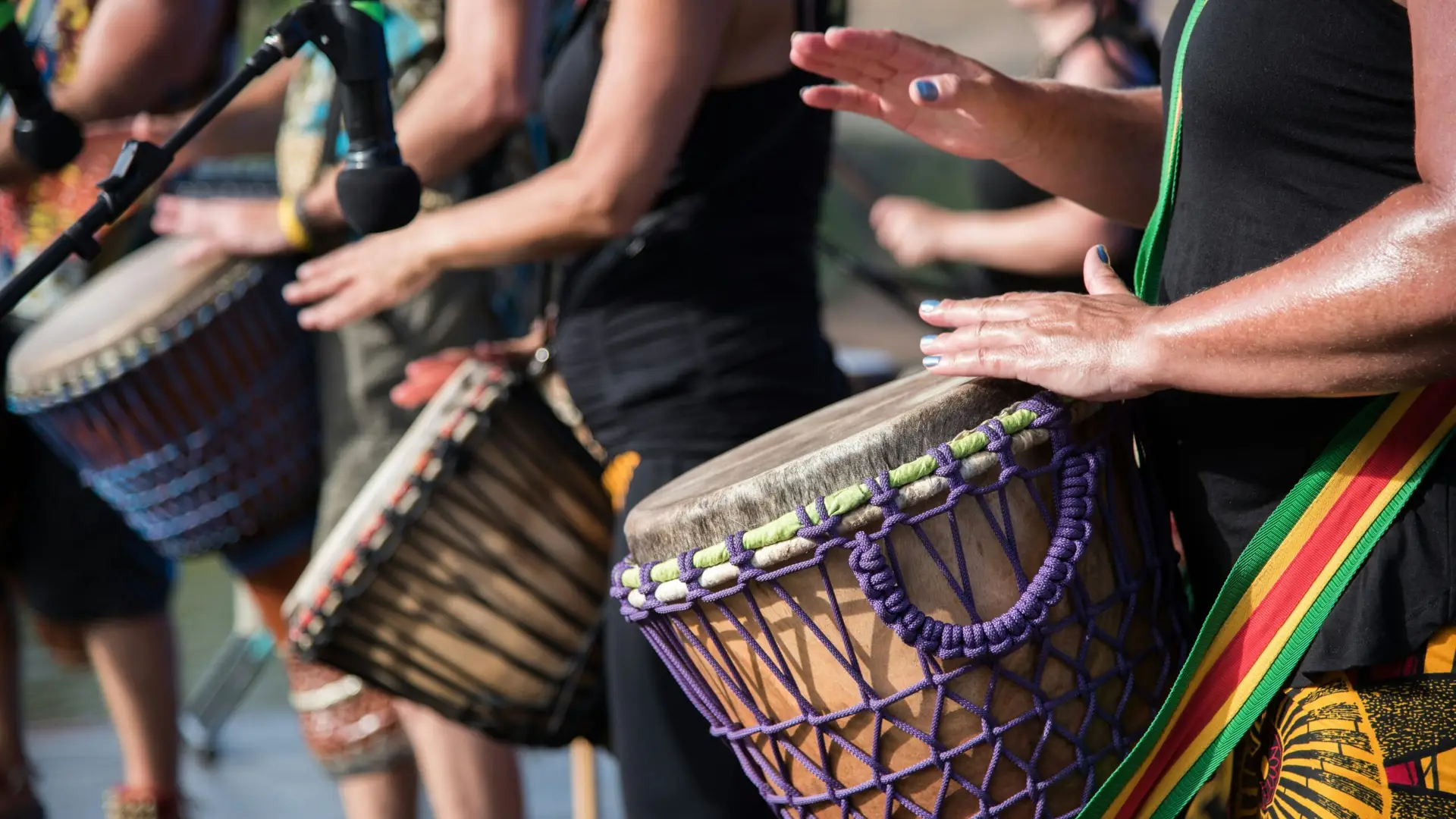
Running drum circles with my elementary students has become one of the most joyful parts of teaching. With games from Kalani Das and Arthur Hull, I’ve watched how a little novelty can turn repetition into play, helping techniques and grooves stick. Hand drums lower the barrier to entry, making it easier for students to jump in and start making music right away while experiencing what it’s like to play as a group.
Always on a quest to improve my teaching and understanding, I’ve attended some training sessions that connect Social Emotional Learning (SEL) to drum circles. These include “Beat the Odds” offered by UCLA Arts and Healing led by Ping Ho and “Rhythm 2 Recovery” by Australian Simon Faulkner (led by Oregon-based music therapist Summer Lall). Both introduced activities and games that use drumming as a vehicle to create social cohesion and open the door for conversations about personal values and relationships.
Pairing drumming and SEL turns rhythm into metaphor. In one call and response game from Rhythm 2 Recovery, students copy every pattern played by the facilitator except the one representing aggression, answering with a gentle rumble instead. In a game from Beat the Odds,students pass shakers around, which represents how much you give or take in relationships.
A growing body of research supports the use of drum circles as an intervention across diverse groups. For example, studies of group drumming with adults have shown measurable improvements in biological, psychological and social measures of stress, particularly when reflection and self-disclosure are incorporated. (Bittman, Berk, Felten, et al, 2001; Fancourt, Perkins, Ascenso, et al, 2016)
West African Wisdom
Most of what is found in these modern programs connects to older, indigenous traditions. Ewe drummer CK Ladzekpo from Ghana has described how his training in drumming was inseparable from his character development. Ladzekpo says that if he avoided the tension created by certain “cross-rhythms” he would be “severely punished.” Such avoidance was interpreted not merely as a technical failure, but as a reflection of his unwillingness to confront “the real challenges of life.” The correction often came in the form of philosophical guidance, with the underlying lesson being that challenges should be transformed into opportunities rather than avoided. (Ladzekpo, 1995)
Ladzekpo’s learning also balances personal with social learning. In his culture, they recognize “artistic elements as real-life characters.” (Ladzekpo, 1995) The drums themselves are seen to represent members of a family in the Ewe tradition. “The bell is like the heartbeat which keeps things steady. Kagan is the baby brother; Kidi is the mother; Sogo is the elder brother; Kroboto and Totogi, when they are played, are the twin brothers; Atsimewu, the master drum, is the father, who, according to their tradition, is in charge of everything.” (Chernoff 1979, pg. 43)
Many drums across the African diaspora are tuned to varying pitches, or “voices.” Each plays a unique rhythm pattern, symbolizing individuality while creating “conversation.” It is a poignant metaphor for a community, interdependent individuals each with their own unique roles, characters and contributions relying on one another to create collectively.
If you would like to explore how these drums sound and look, visit the link below for interactive audio that will let you explore each part as an Ewe drum ensemble, individually or in different combinations.
Sometimes one rhythm can be difficult to maintain against another, almost as if the two parts are pulling against each other. In one of the Rhythm 2 Recovery exercises, holding your rhythm while others are playing contrasting or “distracting” parts is seen to represent holding to your values when others are trying to pull you toward their beliefs.
There is a powerful feeling that emerges when people truly tune into one another and groove together. In her book Art Cure, Daisy Fancourt shares research demonstrating how the arts benefit both mental and physical health. It’s no surprise then to discover that communal music-making like singing, dancing and playing music together are central to most indigenous cultures around the world. I’m excited to be part of communities working to bring this kind of shared creative practice back to industrialized cultures.
Ping Ho and associates have studied the use of drum circles in schools and found them to be a powerful tool for building community and connection. In one example, students who didn’t typically get along were brought together for group drumming and began to form a shared group identity. As one school counselor observed, when she incorporated drumming into her counseling groups, the students stopped fighting with each other because, as they put it, ‘you don’t beat up a member of your group.’ (Ho, Chinen, Streja, et al, 2011)
Drumming together asks us to be present, to listen, to hold our own while staying connected to those around us. These aren’t just musical skills — they are the foundations of healthy relationships and resilient communities. In bringing these practices into the classroom or other facilities, we aren’t inventing something new. We’re returning to something old, and finding that it still works. At the end of the day, drumming together just feels good. And in a world that can always use more connection and more joy, that might be the most important benefit of all.
References
Chernoff, John Miller (1979), African Rhythm and African Sensibility, University of Chicago Press
Chinen K, Streja L, Kreitzer MJ, & Sierpina V. (2011 ) Teaching group drumming to mental health professionals. EXPLORE: The Journal of Science and Healing, 7(3): 200-202.
Ladzekpo, C. K. (1995). Developmental techniques of cross rhythms. Sourced from: Ho P,
https://www.richardhodges.com/ladzekpo/Developmental.html
https://thisworldmusic.com/agbekor-african-drumming-and-dance-from-ghana/
Photo by Lee Pigott on Unsplash
