Level: Elementary (recommended grades 2–4)
Duration: ~10–15 minutes
Context: Conversational Solfege Stage 3 — Decode: Familiar
Objectives
- Students can decode familiar rhythm patterns combining 3 quarter notes and 1 eighth-note pair using rhythmic solfege syllables.
- Students can identify the organizing principle of the pattern series: the eighth-note pair (Du-de) shifts one beat position forward in each successive pattern.
Rationale
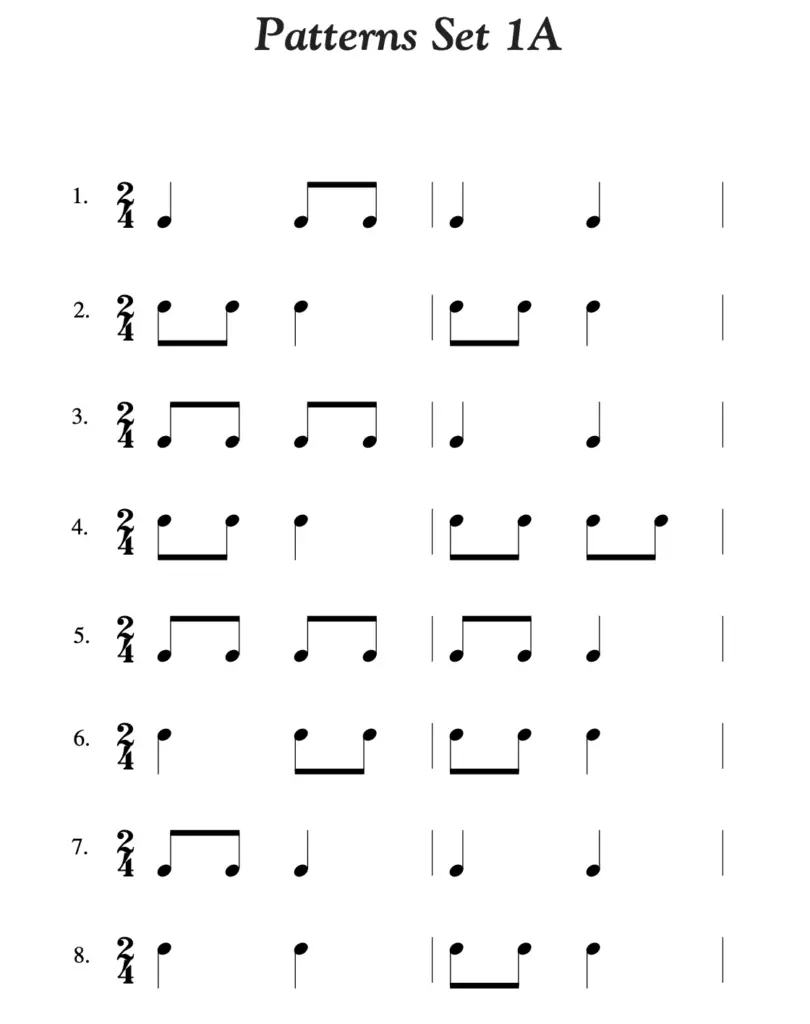
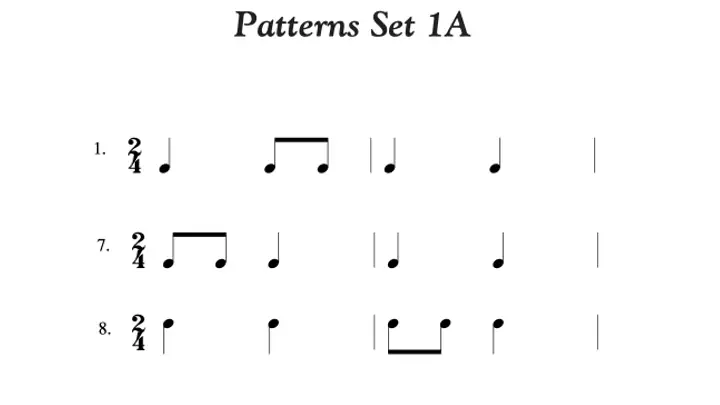
This lesson scaffolds Unit 1: Stage 3: Decode: Familiar stage of Conversational Solfege by limiting the pattern set to a single variable — the beat position of the Du-de — while keeping everything else constant. The puzzle-finding structure increases engagement and supports awareness of rhythmic organization. I have found my students struggle when initially decoding familiar patterns when presented with them played on a drum, percussion instrument or when I give a neutral syllable. By focusing initial decoding on patterns 7, 1 & 8 respectively of Pattern Set 1A it provides some constraints that I have seen unlock understanding in my students.
Materials / Setup
Students and teacher seated in a circle. No materials needed beyond the teacher’s hands for beat tracking.
Procedure
1. Connect to prior learning Briefly review the syllables being used: “You’ve been echoing rhythm patterns using Du and Du-de. Today we’re going to decode some patterns, decoding means hearing a rhythm spoken with a neutral syllable and translating it into Du and Du-de. That is called decoding. I am going to speak some rhythms using a neutral syllable See if you can crack the code.”
2. Present the patterns Teacher holds up 4 fingers to represent the 4 beats and chants patterns 7, 1 & 8 from pattern set 1A in order using neutral syllables, one at a time.
3. Scaffold: count the syllables “Before we decode, let’s look at the ingredients. How many Du’s and how many Du-de’s are in each pattern? Is it the same every time?”
Guide students to confirm: every pattern has exactly 3 Du’s and 1 Du-de.
4. Decode Students decode each of the three patterns aloud together, one at a time. Correct gently as needed, re-modeling before moving on.
5. Surface the pattern “Now that we can speak all three — does anyone notice something about which beat the Du-de is landing on each time?”
If students need a nudge: chant through all three patterns again slowly, touching each finger as you go and pausing slightly to emphasize the Du-de’s position. Offer the scaffold: “The Du-de is on a different beat each time. Watch my fingers.”
Once a student names it, reinforce: “The Du-de is on beat 1 in the first pattern, beat 2 in the second, beat 3 in the third.”
6. Predict the 4th pattern “If we keep going with this pattern… what would the fourth rhythm pattern sound like?”
Give students a moment to think or quietly try it out. Call on a volunteer. Confirm: “The Du-de moves to beat 4.”
Chant the 4th pattern together as a class. This pattern appears later in pattern set 1B.
7. Chant all four in sequence Chant patterns 1 through 4 consecutively, reinforcing the full arc of the puzzle.
Formative Assessment
Teacher shuffles the order of the four patterns (e.g., eighth note pair on either beat 3, 1, 4, or 2) and moves around the circle one student at a time. Each student decodes one pattern each delivered to them using neutral syllables. Teacher notes which beat positions cause hesitation for follow-up in future lessons.
Possible Extensions
Introduce a fifth “bonus” challenge: what if the Du-de appeared on two beats at once. Have students decode patterns 3 & 6 of Pattern Set 1A and see if they could continue the pattern of the Du-de’s on two beats moving forward by a beat (creating Du Du Du-de Du-de).